Article Source:Stone Wisdom Technology | Author:Stone Wisdom Technology | Time:2025-12-10
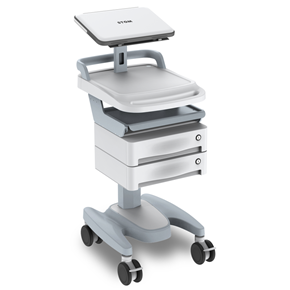
In the bustling wards, emergency rooms, and examination departments of hospitals, medical staff often need to move monitors quickly and transport various medications and instruments back and forth between beds. A scientifically designed, flexible, and reliable mobile auxiliary device can often serve as an "invisible assistant" in nursing work. The ST-T3 Medical Cart (commonly referred to as the Monitor Cart/Mobile Nursing Cart) is a classic tool built precisely for such scenarios. How does it empower daily medical work through thoughtful design details? Let’s take a closer look.
I. Precise Positioning: More Than Just a "Cart", But a Mobile Workstation
The core positioning of the ST-T3 Cart is clear: safe loading and flexible transportation. It mainly undertakes two key functions:
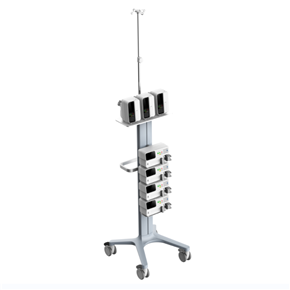
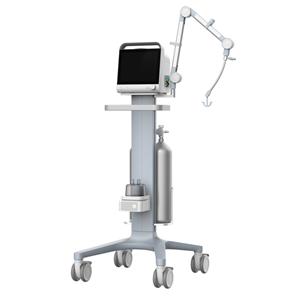
- Equipment Platform: It provides a stable placement for commonly used devices such as ECG monitors, infusion pumps, and small ventilators, enabling "devices to move with personnel" and quickly setting up monitoring or treatment units at the bedside.
Nursing Storage: It systematically stores nursing supplies including medications, syringes, dressings, and medical records, acting as a "mobile nursing station". This reduces the need for nurses to repeatedly travel between the nurse’s station and wards, thus improving work efficiency.
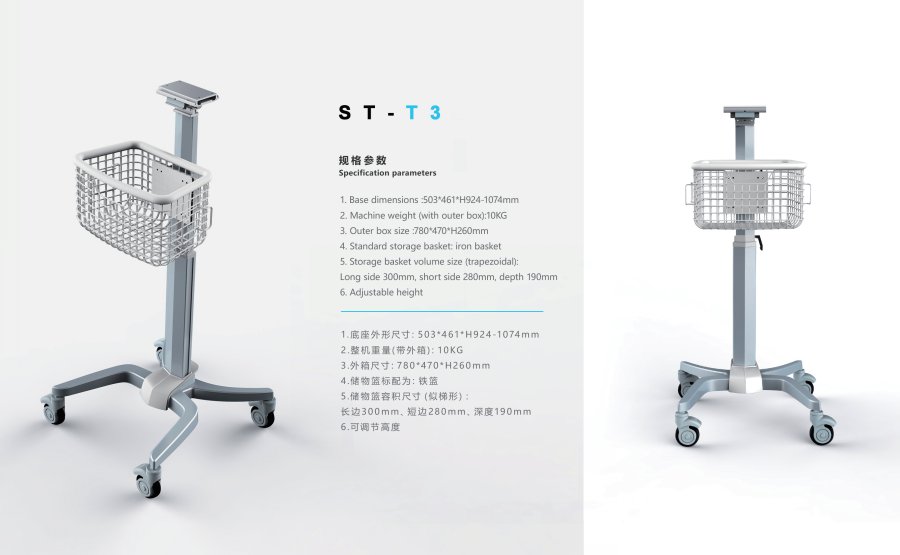
II. Design Decoding: The Balancing Art of Stability, Flexibility and Storage
Its structural design fully takes into account the actual needs of the medical environment:
- Foundation: Four-Wheel Mute BaseThe four-wheel structure offers excellent stability and anti-tipping capacity, ensuring smooth movement even when carrying heavy equipment or making quick turns. The mute casters enable quiet movement in ward areas, avoiding noise disturbance to patients’ rest and reflecting humanistic care
- Support: Height-Adjustable ColumnThe central column supports height adjustment, a seemingly simple yet crucial function. It allows medical staff to adjust the cart to the most comfortable and labor-saving height according to their own height, equipment requirements, or operational habits (such as standing for documentation or sitting for operation). This ergonomic design reduces fatigue from long-term use.
- Core Loading: Trapezoidal Storage Basket and Top Plate
- The upper iron storage basket adopts a trapezoidal design (long side 300mm / short side 280mm / depth 190mm). This shape facilitates classified storage of items, offers a wider front view for easy access, and the iron material is sturdy, durable, and easy to clean and disinfect.
- The top equipment platform provides a spacious and stable placement area for monitors and other devices, serving as the "main operation console" of the cart.
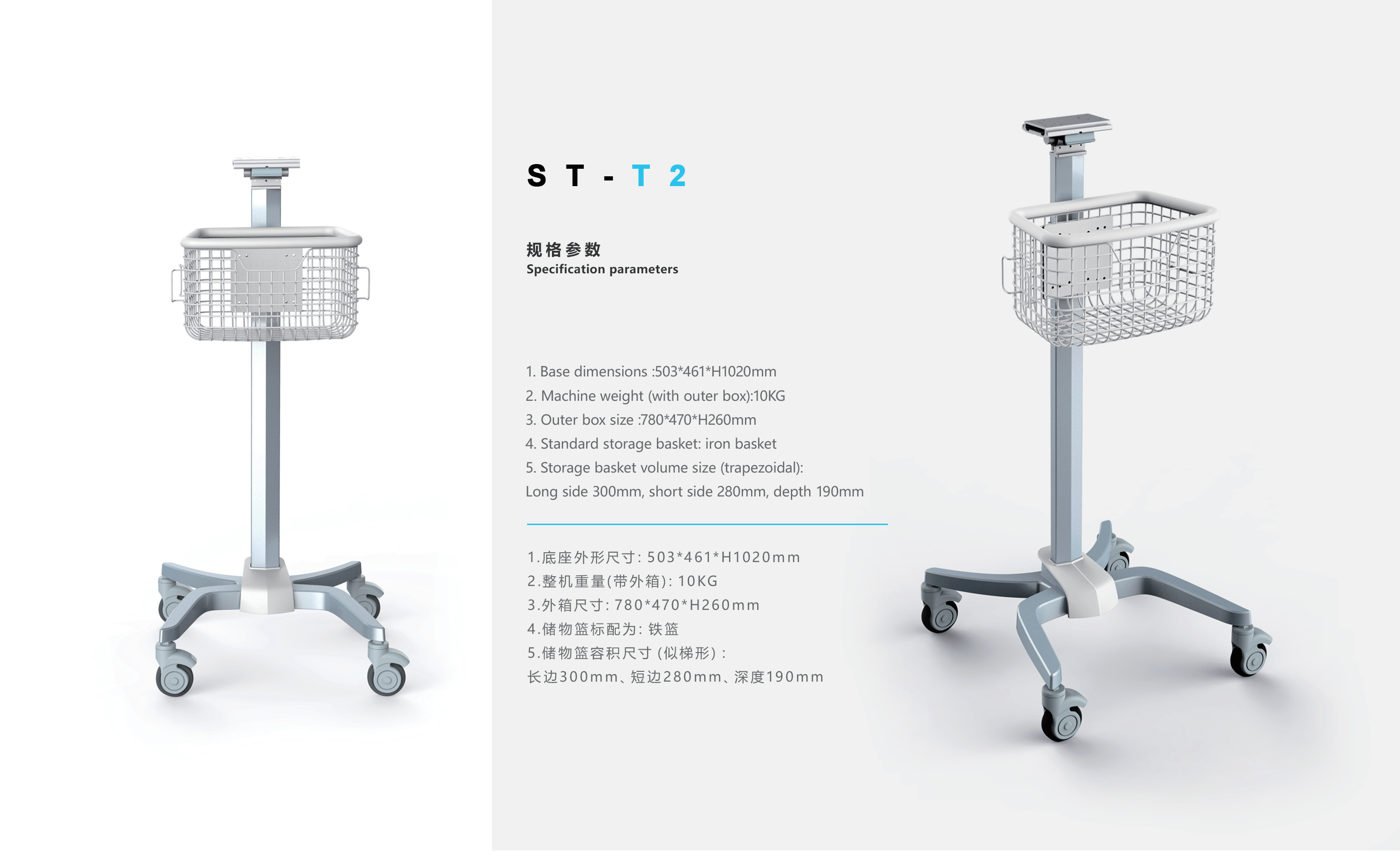
III. Key Parameters: Adapting to Hospital Spaces and Workflows
IV. Scenario Applications: Covering Nursing Workflows Across Multiple Stages
The value of the ST-T3 Cart is particularly prominent in the following scenarios:
- Daily Ward Rounds: Nurses can complete vital sign measurement, medication administration, and record-keeping for multiple patients in one trip with the cart.
- Emergency Rescue and Patient Transfer: It quickly carries essential equipment to form a mobile emergency unit, racing against time to save lives.
- Examination Department Support: In departments such as ultrasound and radiology, it serves as a mobile carrier for equipment, improving device utilization rates.
- Medication and Material Management: It is used for intra-department medication delivery and material replenishment, enabling refined management.
Conclusion
Although the ST-T3 Medical Cart does not directly participate in treatment, it profoundly impacts the efficiency and safety of clinical work by enhancing device accessibility, optimizing item management, and reducing staff workload. Behind it lies a meticulous observation of medical workflows and an engineering-oriented solution approach. Choosing a suitable mobile nursing cart is essentially equipping an efficient medical team with reliable infrastructure, allowing medical staff to serve patients more attentively and calmly.




 WeChat
 Online Service